For weeks, my kitchen counter has been a battleground of fluffy grains, starchy steam, and constant morning beeps. If you are trying to decide between a Tiger vs Toshiba rice cooker, you are likely looking for a smart, multi-functional kitchen helper. Both brands use Fuzzy Logic technology to take the guesswork out of making dinner.
I cooked white, brown, and mixed grains daily in both machines to see which is better for a busy home. The Tiger JBX-A10U is best for busy parents who want to steam a side dish while cooking rice. The Toshiba TRCS01 is the ultimate budget-friendly pick for those who prioritize a simple interface and heavy-duty pot. Let us look at how they actually perform when you are rushing to get food on the table on a Tuesday night.
Side-by-Side Specs Comparison
These two cookers look different on the counter, but they share very similar technology under the hood. Let us compare their key specifications side by side.
| Feature | Tiger JBX-A10U | Toshiba TRCS01 |
|---|---|---|
| Price Tier | Mid-range | Budget |
| Capacity (Cups Uncooked) | 5.5 Cups | 5.5 Cups |
| Wattage | 672W | 650W |
| Heating Type | Micom | Micom |
| Number of Menu Settings | 8 | 7 |
| Inner Pot Material | Multi-layer ceramic | Heavy-duty non-stick |
| Timer and Keep-Warm | Delay timer / 12 hr | Delay timer / 24 hr |
| Warranty | 1 Year | 1 Year |
It is a good idea to check the current price and specs of each model before you make your final choice.
Unboxing and First Impressions
Unboxing both units felt like opening two very different kitchen gifts. Inside both boxes, you get a plastic measuring cup, a plastic rice paddle, and a user manual. The Tiger also comes with a special BPA-free cooking plate. This plate lets you cook rice and steam a side dish at the same exact time. The included measuring cup is smaller than a standard kitchen cup, holding about 180 ml. This is normal for Asian rice cookers, but you must use it to get the right rice-to-water ratio.
The first run with both cookers brought a very slight plastic smell, which is typical for new heating elements. This scent faded completely after one washing. The Toshiba felt incredibly solid, with a thick inner pot that surprised me with its weight. The Tiger felt a bit lighter overall but looked very modern with its sleek design. On my first batch of white rice, the Tiger was simple to start. The Toshiba had a few button icons that made me check the manual first, but I got the hang of it quickly.
Build Quality and Materials
When buying an appliance you will use daily, how it is built matters just as much as how it cooks. Here is a breakdown of how these cookers feel and function in the hand.
Inner Pot Material and Coating
The Tiger has a high-quality inner pot coating made of multi-layer ceramic. It feels smooth and has proven to be highly durable over weeks of daily washing. The Toshiba features a heavy-duty, ultra-thick non-stick coating. This thick pot retains heat beautifully, which helps cook each grain evenly from top to bottom.
Lid Design and Steam Vent
The lid on both cookers opens with a satisfying click of a push button. Each has a removable inner lid that makes cleaning starch off the top easy. Steam escapes through a built-in steam vent on top of the lid. The Toshiba vent is slightly larger, which seems to prevent any messy starchy bubble-overs during high-heat cooking cycles.
Heating Plate and Controls
Both devices use a bottom heating plate that coordinates with Fuzzy Logic microcomputers. The control panel on the Tiger is flat and easy to wipe down. The Toshiba features a large LCD display that is easy to read, even in a dim morning kitchen when you are half-asleep.
Cord, Handle, and Overall Sturdiness
The Toshiba wins big on storage convenience thanks to its retractable power cord. The Tiger uses a detachable cord, which is easy to store inside the pot but can get lost in a cluttered cabinet. Both have sturdy swing-up handles that make them easy to carry.
Safety Features
Each cooker features an automatic shut-off that prevents the heating element from overheating. The cool-touch exterior of both machines works well. They both stay completely safe to touch, even when the inner pot is boiling rapidly.
Cooking Performance — Will It Actually Make Good Rice?
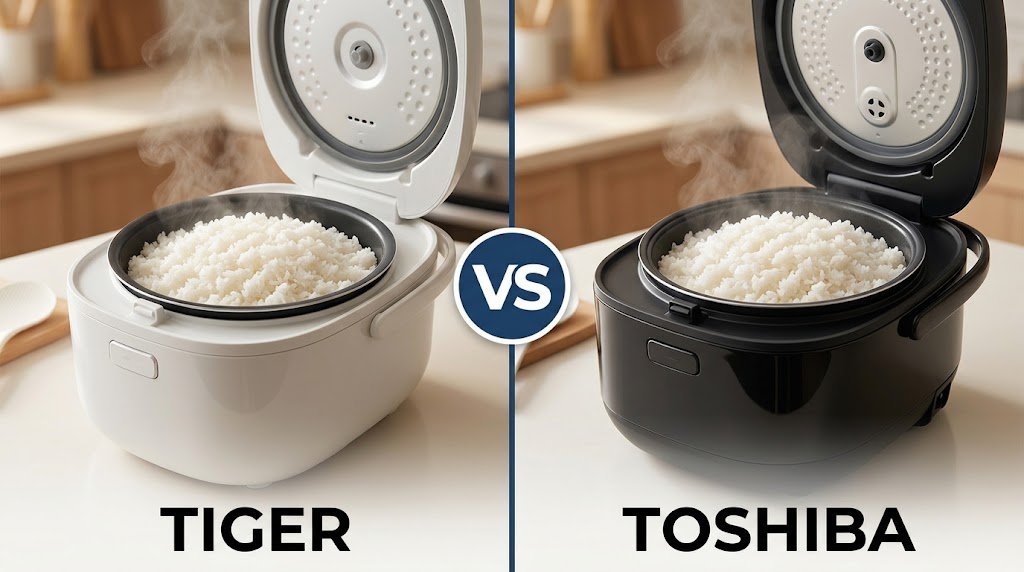
The ultimate test of any Tiger vs Toshiba rice cooker comparison is how the grains taste in the bowl. Over a few weeks, I tested various types of rice to see how the textures differed.
The white rice texture from both machines was a massive upgrade over a basic one-touch cooker. Jasmine rice came out fragrant and fluffy, with excellent grain separation. I noticed that the Tiger excels at keeping the grains shiny and distinct. The sushi setting on the Tiger gave me sticky sushi rice that held its shape perfectly without turning mushy.
If you cook brown rice, you know it can easily turn out chewy or tough. The Toshiba features a dedicated brown rice setting that is easily the best rice cooker for brown rice in this price tier. It mimics premium induction models by cooking the grains slowly, making them soft and tender. The Tiger also did a fine job with brown rice, but the grains were slightly firmer. Neither machine produced dry edges or a scorched bottom, even when I let the rice sit for hours.
Cooking Speed and Convenience
Micom cookers are not built for speed, as they adjust cooking temperatures slowly to get the best texture. Let us look at how much time you need to plan for each meal.
| Feature | Tiger JBX-A10U | Toshiba TRCS01 |
|---|---|---|
| White Rice Cook Time | Shorter (Approx 40 mins) | Longer (Approx 50 mins) |
| Brown Rice Cook Time | Standard (Approx 70 mins) | Longer (Approx 80 mins) |
| Delay Timer | Yes (Double memory) | Yes (Single memory) |
| Quick Cook Option | Yes | Yes |
| Preset Usefulness | High (Tacook mode) | Moderate |
| Hands-On Time | Very Low | Very Low |
Both cookers are perfect for busy families because they require zero monitoring while running.
While the cooking time is longer than a basic pot on the stove, the delay timer makes it easy to plan ahead. I loved setting the delay timer the night before. Waking up to the smell of fresh jasmine rice at 6 a.m. made busy mornings feel much calmer. The Tiger has a dual timer memory, which lets you save breakfast and dinner times separately.
Keep-Warm Performance and Rice Freshness
A reliable keep-warm function is essential if your family eats meals at different times of the day. Here is how the rice holds up over several hours.
| Feature | Tiger JBX-A10U | Toshiba TRCS01 |
|---|---|---|
| Keep-Warm Duration | Up to 12 Hours | Up to 24 Hours |
| Rice Feel After 2 Hours | Moist and fresh | Fluffy and hot |
| Rice Feel After 8 Hours | Slightly dry on top | Soft and warm |
| Edge Yellowing or Crusting | Very minimal | None |
| Smell on Keep-Warm | Clean | Neutral |
| Energy Draw on Warm | Low | Low |
The Toshiba can keep rice fresh for up to 24 hours, though I recommend eating it much sooner for the best quality.
After four hours on keep-warm, the rice in the Toshiba still tasted fresh and retained its moisture. The Tiger keeps rice perfect for up to twelve hours, but I noticed a tiny bit of dryness on the very top layer after eight hours. Neither cooker caused the rice to turn yellow or develop a strange, stale smell. For best results, I always fluff the rice immediately after cooking to release excess steam before letting the keep-warm mode take over.
Design and Controls
The visual appeal of your kitchen tools can make cooking feel like less of a chore. Here is how these two stack up visually and functionally.
| Feature | Tiger JBX-A10U | Toshiba TRCS01 |
|---|---|---|
| Exterior Material | Matte dark gray plastic | Stainless steel and black |
| Control Panel and Display | Flat panel, orange LCD | Large angled LCD |
| Lid Type and Handle | Push button, carry handle | Push button, carry handle |
| Cord Storage | Detachable cord | Retractable cord |
| Countertop Footprint | Deep and narrow | Wide and rounded |
| Overall Feel | Sleek and modern | Classic and robust |
If you have a small kitchen, the Tiger has a slightly narrower footprint, which leaves you more countertop space.
The Tiger panel has clear labels, though I ignored most menu settings after the first week and stuck to white rice, brown rice, and the Synchro-Cooking function. The Toshiba panel is incredibly intuitive. The large start button is easy to hit, and the screen shows a clear countdown timer during the last several minutes of cooking.
Noise, Steam, and Smell
Both machines operate quietly. The noise level is so low that you will only hear a gentle simmer when standing right next to them. The Toshiba does beep loudly when the cooking cycle finishes. If your kitchen is near the bedrooms, that 6 a.m. beep will definitely wake up light sleepers.
Steam release is gentle on both models. A small plume of vapor escapes from the steam vent, but it does not leave a huge puddle on your cabinets. The smell of cooking rice is pleasant and comforting. However, during the first few uses, you might notice a faint warm-metal smell from the heating plate. This is normal and disappears quickly.
Capacity and Portion Control
Understanding how much rice these machines make is crucial for feeding your family without wasting food. Here is how the capacity translates to real-world meals.
| Feature | Tiger JBX-A10U | Toshiba TRCS01 |
|---|---|---|
| Measuring Cup Included | Yes (180 ml) | Yes (180 ml) |
| Water Line Clarity | Good contrast | Excellent contrast |
| Best Batch Size | 2 to 4 cups | 2 to 4 cups |
| Minimum Batch That Works Well | 1 cup | 1 cup |
| Family Size Suitability | Family of four | Family of four |
| Leftover Storage | Moderate | Easy |
Both models are perfect for a family of four, but they can easily scale down for a single person.
When you use the included cup, the water lines inside the removable inner pot are incredibly accurate. The Toshiba has high-contrast white lines on a dark background, which are very easy to read. Cooking just one cup of rice for one person works beautifully in both cookers. The rice does not burn or stick to the bottom, which is a common issue with cheaper models.
Ease of Use and Daily Routine
A kitchen appliance is only useful if it does not make your life harder when it is time to clean up. Let us see how they fit into a busy evening routine.
| Task | Tiger JBX-A10U | Toshiba TRCS01 |
|---|---|---|
| Inner Pot Cleanup | Quick wipe down | Effortless wipe |
| Lid and Vent Cleanup | Removable cap and inner lid | Removable cap and inner lid |
| Storage Convenience | Detachable cord | Retractable cord |
| Speed of Starting a Batch | Two button presses | Two button presses |
| Best Use Case | Meal prepping side dishes | Reliable daily rice |
| Risk of Boil-Over or Sticking | Extremely low | None |
For overall ease of cleaning, both models make life incredibly simple.
The non-stick coating on the inner pots means that leftover rice slides right out with warm, soapy water. There are no dishwasher-safe parts, so you must hand-wash the pots to protect the coating. The inner lid pops out with a simple tab, making it easy to rinse off any starchy buildup under the tap. The daily ease of cleaning ensures a quick cleanup after a long day of work.
Performance and Durability Over Time
After weeks of heavy use, both of these cookers still look and perform like new. I have not noticed any degradation in the non-stick coating of either pot. The buttons remain clicky and responsive, and the steam vents have not clogged or shown any signs of wear.
The Tiger multi-layer ceramic coating feels exceptionally tough. It seems highly resistant to the accidental scratch if someone uses a metal spoon by mistake. The Toshiba has a robust build quality that suggests it will last for many years on your counter. I would feel comfortable keeping either of these machines as a permanent fixture in my kitchen.
Price and Value for Money
When deciding between a Tiger vs Toshiba rice cooker, your budget will play a major role. The Toshiba sits firmly in the budget-friendly price tier, making it a highly attractive option. It offers incredible value for money because it delivers rice texture that rivals machines costing twice as much.
The Tiger is in the mid-range price tier. Is it worth the money to spend more on the Tiger? Yes, if you will actually use the “Tacook” synchro-cooking feature to cook your main dish and rice together. If you just want a reliable cooker for standard grains, the Toshiba is an exceptional value. Remember to check the current price online to see if there are any active discounts before you make your purchase.
How It Compares to Similar Products
It is helpful to see how these two brands stack up against other popular choices on the market.
Zojirushi NS-TSC10
This premium Micom cooker is a favorite for many, but it sits in a higher price tier than the Toshiba. The Zojirushi offers slightly softer rice texture and a louder musical alert, but the Toshiba matches its performance at a much lower cost.
Hamilton Beach Advanced Multi-Cooker
This budget cooker offers great versatility but lacks the advanced Fuzzy Logic sensors of the Tiger and Toshiba. Your rice might occasionally have hot spots or dry edges in the Hamilton Beach, which never happens with the Tiger or Toshiba.
Who Should Buy Which?
Choosing the right machine comes down to how you cook and how you plan to use it daily.
Buy the Tiger JBX-A10U if:
- You love the idea of one-pot meals and want to steam veggies or meat while cooking rice.
- You want a sleek, modern, dark-colored appliance that looks great on a contemporary counter.
- You appreciate a dual delay timer to manage breakfast and dinner effortlessly.
Buy the Toshiba TRCS01 if:
- You want the absolute best value for money without sacrificing taste or build quality.
- You regularly cook brown rice and want the softest, most tender texture possible.
- You hate dealing with loose cords and want the convenience of a retractable power cord.
Consider Neither If:
- You are always in a rush and want your rice cooked in under twenty minutes.
- You need to feed a massive crowd of more than eight people on a regular basis.
Long-Term Ownership Considerations
Taking care of your cooker will ensure it lasts for years. Always use the plastic rice paddle or a wooden spoon to serve your food, as metal utensils will scratch the inner pot coating. Replacement parts, like a new inner pot or a fresh silicone gasket, are easy to find online for both Tiger and Toshiba.
Both brands offer a standard one-year warranty that covers manufacturing defects. The energy use of these Micom cookers is very low, drawing minimal power once they switch to the keep-warm function. Because they cook so evenly, you will waste less food from burnt or crusty bottoms over hundreds of batches.
Capacity and Energy Use: Tiger vs Toshiba rice cooker
Choosing the right size is important for your kitchen space and your family size suitability. Both of these machines have a capacity of 5.5 cups of uncooked rice, which yields about 11 cups of cooked rice. This makes them the perfect size for a family of four, offering plenty of food for dinner and some leftovers for lunch the next day.
If you are cooking for one person, these models still perform incredibly well with small batches. Some large cookers fail when you only cook a single cup, but both of these manage small portions without drying out the grains. They draw between 650 and 672 watts of power during the active boiling phase, which is very efficient and will not spike your electricity bill.
See more about Tiger Vs Cuckoo Rice Cooker: 2026 Comparison
Final Verdict
After weeks of daily testing, the Toshiba TRCS01 stands out as the overall winner for the average kitchen. It delivers phenomenal, fluffy rice, boasts a remarkably thick inner pot, and features a convenient retractable cord. It offers the performance of a high-end machine at a budget-friendly price point, making it a fantastic deal.
However, the Tiger JBX-A10U is an incredible option if you want to save time by cooking double-decker meals. Its ceramic-coated pot is highly durable, and the modern design looks fantastic on any counter. Both cookers represent a massive upgrade over basic models, and you will taste the difference in every single bowl.