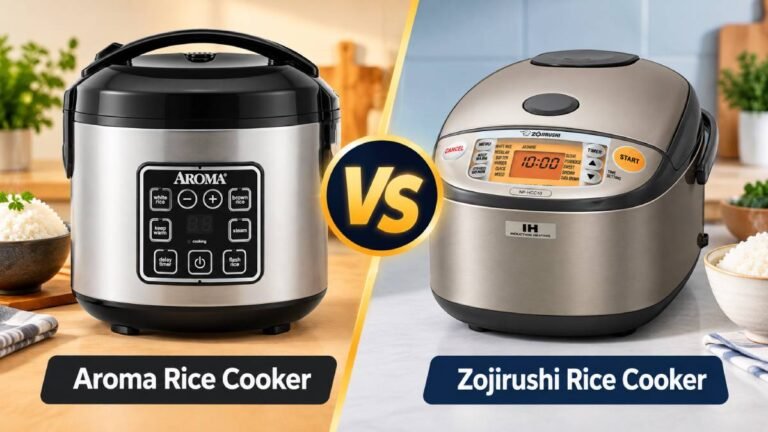
I spent several weeks cooking white rice, brown rice, and oatmeal in my own kitchen to settle the ultimate debate: Panasonic rice cooker vs Zojirushi. If you want a dependable Micom fuzzy logic machine, choosing between these two brands can feel impossible. One is a sleek, modern multi-cooker, while the other is a classic kitchen workhorse.
This comparison will help you decide which brand fits your daily routine, your budget, and your counter space. After eating bowls of rice daily, I found clear differences in texture, ease of cleaning, and overall value. Here is my honest, hands-on take on how these two kitchen giants match up.
Panasonic rice cooker vs Zojirushi: Side-by-Side Specs Comparison
Comparing the technical specifications helps show the main difference between these two popular kitchen appliances. Here is how they stack up on paper.
| Feature | Panasonic SR-CN108 | Zojirushi NS-TSC10 |
|---|---|---|
| Price Tier | Mid-range | Premium |
| Capacity (Cups Uncooked) | 5.5 Cups | 5.5 Cups |
| Wattage | 765W | 610W |
| Heating Type | Fuzzy Logic (Micom) | Fuzzy Logic (Micom) |
| Number of Menu Settings | 16 Settings | 10 Settings |
| Inner Pot Material | 2.2mm 6-layer Non-stick | Thick Black Non-stick |
| Timer and Keep-Warm | 24hr Timer / 12hr Warm | 24hr Timer / 12hr Warm |
| Warranty | 1-Year Limited | 1-Year Limited |
Be sure to check the current price and exact specs online before making your final purchase.
Unboxing and First Impressions
Unboxing both units was straightforward, and both came with a measuring cup, a plastic rice paddle, a steam tray, and a clear manual. When handling them, the Zojirushi felt a bit more robust with its sturdy carrying handle and retractable power cord. The Panasonic had a modern look but felt slightly lighter in the hand. I did notice a very faint, typical new-appliance plastic smell on the first heating cycle of both, but a quick rinse of the pots sorted that out instantly.
The first batch of white jasmine rice in both cookers turned out wonderfully, though I had to remember that the included measuring cup is smaller than a standard kitchen cup. It holds about 180 ml rather than the standard 240 ml, which directly affects your rice-to-water ratio. The manuals are easy to read, but the Panasonic menu buttons took me a few minutes to figure out compared to the very clear, classic layout on the Zojirushi.
Build Quality and Materials
Both brands use premium materials, but their design philosophies differ quite a bit when you look closely. Let us break down how they feel after weeks of daily bumps and washes in a busy kitchen.
Inner Pot Material and Coating: The Panasonic features a heavy, 2.2mm thick inner pot with a multi-layer non-stick coating that feels incredibly durable. The Zojirushi pot is slightly lighter but has a slick, highly resilient inner pot coating that makes rice slide out effortlessly.
Lid Design and Steam Vent: Each cooker has a removable inner lid for easy cleaning. The steam vent cap on both captures starchy foam well, but the Zojirushi inner lid gasket feels slightly thicker and more secure over multiple wash cycles.
Heating Plate and Controls: The heating elements are reliable, but the control panels feel very different. The Zojirushi uses a classic LCD display with clear, simple buttons, while the Panasonic has a sleek, modern touch panel that can sometimes be harder to press with wet fingers.
Cord, Handle, and Overall Sturdiness: Zojirushi wins on convenience with its built-in retractable power cord and solid carrying handle. The Panasonic uses a detachable power cord that you have to store separately, which can clutter your countertop space.
Safety Features: Both models include an automatic shut-off feature to prevent overheating and have cool-touch exteriors so you will not burn your hands while moving them.
Cooking Performance — Will It Actually Make Good Rice?
Cooking performance is where the Panasonic rice cooker vs Zojirushi battle gets interesting because both use fuzzy logic to adjust cooking temperatures. I put them through their paces with white rice, brown rice, and sushi rice to see which is better.
The white rice texture from both machines is excellent, but they have slightly different characters. The Zojirushi produces incredibly fluffy rice with perfect grain separation and a beautiful shine. The Panasonic tends to make rice that is just a touch softer, which is fantastic if you love a slightly stickier jasmine rice.
When it comes to the brown rice setting, the Zojirushi is arguably the best rice cooker for brown rice because it slowly plumps the tough outer bran layer, resulting in a soft, non-chewy bite. The Panasonic also handles brown rice well, but it takes slightly longer to achieve the same tenderness. I did not experience any scorched bottom or dry edges with either machine, even when leaving the rice on warm for a few hours.
For small batches, like cooking just one cup of white rice, both cookers adjusted perfectly without drying out the edges. However, the Zojirushi kept a slightly more consistent texture from the top to the bottom of the pot.
Cooking Speed and Convenience
Fuzzy logic cookers are not known for speed, as they prioritize texture over quick cooking time. Here is how much time you will spend waiting for your meal.
| Feature | Panasonic SR-CN108 | Zojirushi NS-TSC10 |
|---|---|---|
| White Rice Cook Time | About 45-50 mins | About 50-60 mins |
| Brown Rice Cook Time | About 80-90 mins | About 85-100 mins |
| Delay Timer | 24-Hour Dual Timer | 24-Hour Dual Timer |
| Quick Cook Option | Yes (About 30 mins) | Yes (About 35 mins) |
| Preset Usefulness | Very high (16 modes) | High (10 modes) |
| Hands-On Time | Minimal (under 5 mins) | Minimal (under 5 mins) |
Both machines require patience on a busy weeknight, but their quick cook options work well when you are in a rush.
The Panasonic runs slightly faster overall, which might save your dinner plan if you start cooking late. The delay timer on both machines is incredibly helpful, allowing you to set it the night before and wake up to fresh rice.
Keep-Warm Performance and Rice Freshness
If you do not eat all your rice at once, a reliable keep-warm function is essential for keeping leftovers fresh. Here is how the cooked rice holds up over several hours.
| Feature | Panasonic SR-CN108 | Zojirushi NS-TSC10 |
|---|---|---|
| Keep-Warm Duration | Up to 12 Hours | Up to 12 Hours (Extended to 24) |
| Rice Feel After 2 Hours | Fresh and moist | Fresh and moist |
| Rice Feel After 8 Hours | Slightly dry at edges | Still soft and warm |
| Edge Yellowing or Crusting | Minimal | None |
| Smell on Keep-Warm | Neutral | Neutral |
| Energy Draw on Warm | Low | Low |
The Zojirushi keep-warm function is legendary for a reason, as it keeps rice smelling clean and tasting fresh for up to 12 hours without yellowing.
The Panasonic does a fine job for a family dinner, but after about 6 hours, I noticed the edges of the rice starting to dry out slightly. If you plan to leave rice in the cooker all day, the Zojirushi is the superior choice.
Design and Controls
Your rice cooker will likely live on your counter, so the design, display, and cord storage matter for daily use. Here is a look at their physical features.
| Feature | Panasonic SR-CN108 | Zojirushi NS-TSC10 |
|---|---|---|
| Exterior Material | White Plastic / Modern | Stainless Brown Metal |
| Control Panel and Display | Orange LCD / Touch | Clear LCD / Buttons |
| Lid Type and Handle | Push-button / No handle | Push-button / Swing handle |
| Cord Storage | Detachable cord | Retractable cord |
| Countertop Footprint | Moderate | Moderate |
| Overall Feel | Modern and sleek | Traditional and sturdy |
While looks are subjective, the daily interaction with the controls will impact your cooking routine.
The Panasonic looks very modern and fits beautifully in a contemporary kitchen, but the touch buttons can sometimes take two presses to register. The Zojirushi looks more traditional, but the physical buttons click satisfyingly, and the retractable cord is a lifesaver for keeping counters tidy.
Noise, Steam, and Smell
In a small kitchen or open apartment, the sounds and steam from your appliances can be a minor nuisance. The Zojirushi plays a cheerful little melody when it starts and finishes cooking, which is charming but can be a bit loud if you set the delay timer to cook at 6 a.m. while the family is sleeping. The Panasonic uses a more standard, polite beep that is noticeable but less likely to wake up a light sleeper.
Both units handle steam vent release exceptionally well, with a steady, quiet stream rather than a sudden hiss. Starchy foam rarely bubbles over because the fuzzy logic sensors control the heat level carefully. I noticed no lingering plastic smell after the first two runs, and the steam did not leave any sticky residue on my kitchen cabinets.
Capacity and Portion Control
Understanding capacity in cups is crucial so you do not buy an appliance that is too big or too small for your home. Here is how they handle different batch sizes.
| Feature | Panasonic SR-CN108 | Zojirushi NS-TSC10 |
|---|---|---|
| Measuring Cup Included | Yes (180 ml) | Yes (180 ml) |
| Water Line Clarity | Very clear, dark lines | Clear, etched lines |
| Best Batch Size | 2 to 4 cups | 2 to 4 cups |
| Minimum Batch That Works Well | 1 cup | 1 cup |
| Family Size Suitability | Perfect for a family of four | Perfect for a family of four |
| Leftover Storage | Easy to store pot | Easy to store pot |
Getting the exact rice texture you want depends heavily on using the proper measuring tools.
Both of these 5.5-cup models are ideal for a family of four, providing plenty of rice for a main meal plus leftovers. Remember that a “cup” in the rice cooker world is smaller than a standard cup, so always use the included plastic measuring cup to keep your rice-to-water ratio correct.
Ease of Use and Daily Routine
A rice cooker should make your life easier, not add to your sink of difficult dishes at the end of the night. Here is how they fit into daily kitchen chores.
| Task | Panasonic SR-CN108 | Zojirushi NS-TSC10 |
|---|---|---|
| Inner Pot Cleanup | Very easy (wipe clean) | Exceptionally easy |
| Lid and Vent Cleanup | Removable inner lid | Removable inner lid |
| Storage Convenience | Moderate (loose cord) | High (retractable cord) |
| Speed of Starting a Batch | Quick (2-3 clicks) | Quick (2-3 clicks) |
| Best Use Case | Busy families | Daily rice enthusiasts |
| Risk of Boil-Over or Sticking | Very low | None |
An easy cleanup routine ensures you will actually use the appliance instead of letting it gather dust.
Cleaning both cookers is incredibly simple because of the high-quality non-stick coating on the removable inner pot. I found that a soft sponge and warm soapy water cleaned both pots in under thirty seconds, and the removable inner lid keeps starch from building up over time.
Performance and Durability Over Time
After weeks of making white rice, brown rice, and oatmeal, the non-stick coating on both pots showed zero signs of wear or scratching. However, it is vital to never use metal spoons or metal scrubbers on these pots, as a single scratch can ruin the easy cleanup process. The buttons and display screens on both units remained highly responsive, and the gaskets on the inner lids showed no stretching or staining.
If I had to choose one to keep on my counter for the next five years, the Zojirushi feels slightly more built to last. The plastic shell feels thicker, and the retractable cord mechanism is robust. The Panasonic is still an excellent machine, but its sleek exterior plastic seems slightly more prone to fine surface scuffs over time.
Price and Value for Money
When comparing the Panasonic rice cooker vs Zojirushi, budget is going to play a major role in your decision.
The Panasonic sits firmly in the mid-range price tier, making it a highly accessible fuzzy logic cooker for those who want advanced cooking without a premium price tag. The Zojirushi is in the premium price tier, which might give some buyers sticker shock, but its stellar build quality and long lifespan mean the yearly cost of ownership remains incredibly low. Both models can be found easily on popular online marketplaces and major kitchen retail sites, with occasional holiday discounts that make them even more attractive. If you cook rice multiple times a week, the Zojirushi is absolutely worth the money, but if you only cook rice occasionally, the Panasonic offers better overall value for money. Be sure to check the current price of both units before making your choice.
How It Compares to Similar Products
To give you a broader view of the market, here is how these two top-tier cookers stack up against other popular fuzzy logic options.
Tiger JAX-T10U Micom Rice Cooker
The Tiger JAX-T10U is a direct competitor in the mid-to-premium range that offers a unique plate for simultaneous cooking.
Compared to our main two models, the Tiger cooks white rice at a similar speed but produces a slightly firmer grain separation. Its build quality is on par with the Zojirushi, making it a fantastic option for a family of four who likes to steam a protein while cooking rice.
Hamilton Beach 37548 Fuzzy Logic Rice Cooker
This is a budget-friendly alternative for those who want the benefits of fuzzy logic without spending a lot of money.
While the Hamilton Beach cooker is easy to clean and offers decent white rice texture, its build quality feels much lighter and more plastic-heavy. It lacks the premium feel and long-term keep-warm consistency of either the Panasonic or Zojirushi, but it remains a solid choice for occasional users.
Who Should Buy Which?
Understanding the pros and cons of each model is the quickest way to make a decision. Here is a simple breakdown of who will enjoy each cooker the most.
Buy Panasonic SR-CN108 if:
- You want premium fuzzy logic cooking on a mid-range budget.
- You prefer a modern, sleek aesthetic that fits a contemporary kitchen.
- You want slightly faster cooking times for weeknight meals.
Buy Zojirushi NS-TSC10 if:
- You cook rice daily and want the absolute best rice texture and grain separation.
- You need a highly reliable keep-warm function that preserves rice freshness for hours.
- You love convenient design features like a retractable cord and swing handle.
Consider Neither If:
- You are looking for a basic, one-touch cooking switch that finishes in under twenty minutes.
- You have a very small kitchen or are cooking for one person, where a mini travel cooker would fit better.
Long-Term Ownership Considerations
Owning a fuzzy logic cooker is a long-term investment in your kitchen, so it helps to know what to expect years down the road. Both brands offer a standard one-year limited warranty, but their actual lifespan is often much longer if you care for the non-stick coating properly. Avoid using any abrasive sponges, and never wash the inner pot in the dishwasher, as dishwasher-safe parts claims can sometimes degrade the non-stick coating over time.
If you ever need a replacement inner pot or a new lid gasket, Zojirushi parts are much easier to find online compared to Panasonic parts, which can sometimes be out of stock. In terms of energy use, both cookers are highly efficient, using moderate wattage during the active cook cycle and drawing very little power during keep-warm mode. Your yearly cost of ownership will remain very low, especially since these machines are built to deliver consistent results over hundreds of batches.
Capacity and Energy Use: Panasonic rice cooker vs Zojirushi
Selecting the right capacity is essential to ensure you are not wasting energy or countertop space. When looking at the Panasonic rice cooker vs Zojirushi, both models tested here offer a 5.5-cup uncooked capacity, which yields about 11 cups of cooked rice.
This size is perfect for a family of four, providing ample portions for dinner and enough leftover jasmine rice or brown rice for next-day meal prep. These machines also perform beautifully with small batches, meaning couples or even a single person can use them without worrying about the rice drying out or sticking to the bottom. The Panasonic runs at 765 watts, while the Zojirushi operates at 610 watts, making both highly efficient kitchen companions that won’t spike your monthly utility bills.
See more: Tiger Vs Zojirushi Rice Cooker: Which Is Best In 2026?
Final Verdict
Ultimately, both cookers are outstanding and will elevate your home-cooked meals, but the Zojirushi NS-TSC10 takes the crown as the overall winner. Its unmatched keep-warm performance, superior build quality, and user-friendly features like the retractable cord make it worth every penny of its higher price tag. It is the perfect fit for anyone who eats rice daily and demands perfect grain separation.
On the other hand, the Panasonic SR-CN108 is a brilliant contender that offers incredible value for money. It is the best choice for busy families who want modern looks, faster cooking speeds, and high-end results without breaking the bank. Whichever you choose, you can say goodbye to boil-overs and burnt bottom crusts forever.